
Posted in Uncategorized

What is the Caregiver Crisis?

In 2015, the National Alliance for Caregiving and AARP estimated that 43.5 million people provided unpaid care. By 2025, the Johns Hopkins Bloomberg School of Public Health projects this number will rise to 53 million. These caregivers make up most of the 63 million family caregivers in the United States, nearly one in four adults, who provide ongoing care for complex medical conditions or disabilities. (Reinhard et al., n.d.)

The financial impact is significant, particularly from wage losses. A 2024 study by the Columbia University Mailman School of Public Health estimates that unpaid caregiving accounts for about $873.5 billion in uncompensated labor. (McHugh, 2024) Although caregiving is often seen as a family duty, it frequently imposes substantial physical, mental, and financial burdens on caregivers. (ME et al., 2017). Read more
Posted in Cancer, Young Adults

NIH Cancer Institute

A Snapshot of Adolescent and Young Adult Cancers

Cancers Affecting Adolescents and Young Adults (AYAs)

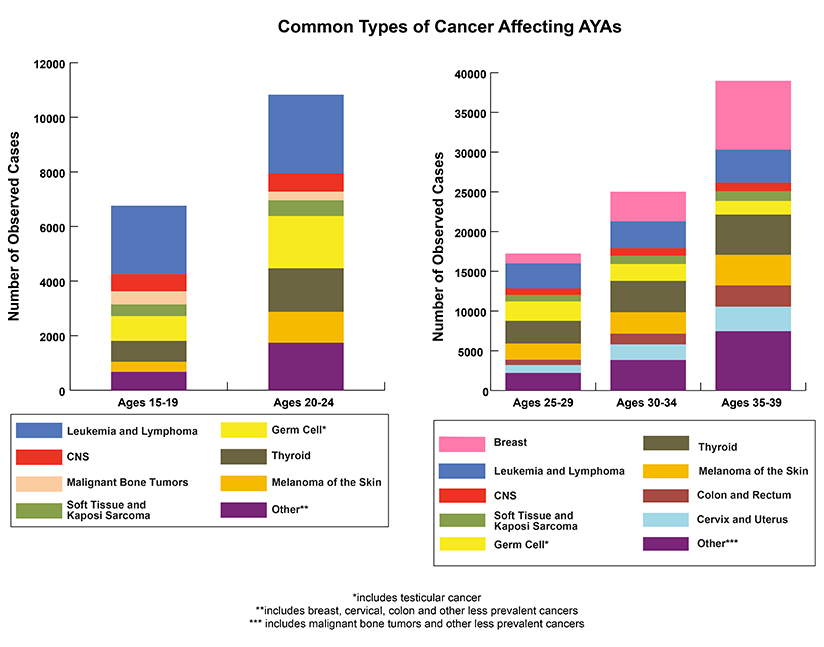
An estimated 69,212 adolescents and young adults (AYAs) ages 15–39 were diagnosed with cancer in 2011.1

This is about six times the number of cases diagnosed in children ages 0–14. The incidence of specific cancer types varies dramatically across the AYA age continuum. For example, leukemialymphomatesticular cancer(germ cell tumors), and thyroid cancer are the most common cancer types in younger AYAs (15–24 years old). By ages 25–39, breast cancer and melanoma comprise a growing share of cancers among AYAs.2

2014_AYA_BAR_v6-side.png

More

Posted in Uncategorized

Education

Education in young cancer survivors

Finding your first job is tougher than ever. But for the seven young people diagnosed with cancer every day in the UK, the barriers are even higher.

Five-year survival rates for 13 to 24-year-olds are over 80%. Young patients often make a full recovery after treatment and have a normal life expectancy. But studies suggest that many miss out on a crucial period in their education or training – which can lead to a constant battle to compete in the jobs market. cont